Orleans East, West and SouthDrainage firstFree written quotes
Driveway paving in Orleans, built around drainage and spring heave
Driveway paving in Orleans costs $5 to $10 per sq ft for new asphalt and $8 to $14 to remove and repave, plus $1,000 to $3,000 where the drainage needs correcting first. Much of Orleans sits on clay that heaves when water stays under the driveway, so Paving Experts Ottawa quotes the drainage before the surface.
We check where water goes before we price the asphalt
Ground conditions confirmed on site, never assumed from a postal code
Base built in compacted lifts, not dumped and levelled
Written quote itemised by depth and by drainage work
Get an Orleans driveway quote
Tell us the size and where the water currently sits.
Every quote is measured and priced on site.
Why Orleans driveways fail the way they do
The pattern here is consistent enough that you can usually predict it from the shape of the damage.
Water under the slab
Frost damage needs three things at once: a frost susceptible soil, freezing temperatures and available water. In Ottawa the first two are fixed. Water is the only variable a contractor controls, and it is controlled in the base and the grade.
Heave, not settlement
A driveway that rises into a hump over winter and drops back in May is not sinking. It is lifting on frozen water in the base. Adding asphalt on top of that does nothing, because the problem is under it.
More cycles coming
The City projects winter freeze-thaw activity rising about 15 percent by the 2030s and 35 percent by the 2050s. A base built for the old cycle count will see more of them than it was designed for.
Completed project
Recent Project in Orleans
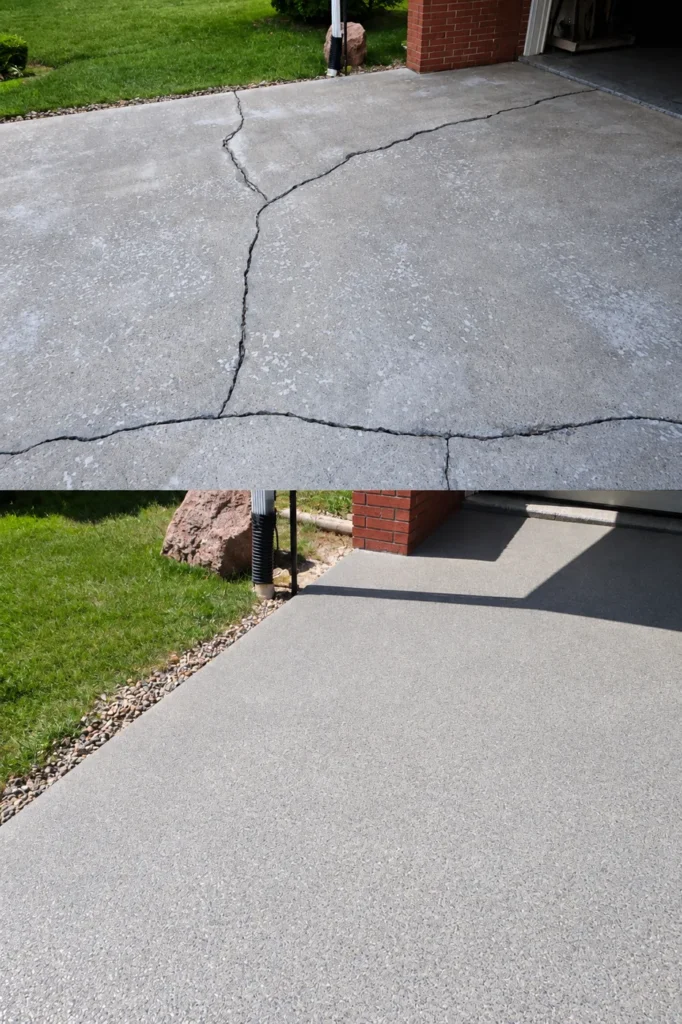
The top photo shows the driveway before the work: an old concrete slab with long cracks running across it. The bottom photo shows the same driveway after the cracks were repaired and the surface was resurfaced with a textured coating. That finish gives better grip than bare concrete and covers the old crack lines. The downspout and lawn edge in the after photo show where the work met the existing landscaping.
Every spring the same calls come in from the same streets. The driveway was fine in November. By the middle of March there is a ridge running across it, a crack that was hairline last year is now wide enough to put a finger in, and a corner has dropped. None of that happened in March. It happened between December and February. Water that soaked into the base in the autumn froze, expanded and pushed the surface up. When the thaw arrives the ice leaves, the ground softens and the raised sections come back down unevenly. Add the weight of a vehicle on softened ground and the damage completes itself. March is simply when it becomes visible. It is also why nobody is paving in Orleans in March: seasonal load restrictions of about 5 tonnes per axle typically run early March to mid May, and those are exactly the trucks that carry aggregate and hot mix.
231.9 cmAverage annual snowfall, 1991 to 2020 normals
757.2 mmAverage annual rainfall
minus 10.0 CJanuary mean temperature
minus 36.1 CRecord low
The ground under Orleans
Much of Orleans sits on Champlain Sea clay, and we confirm on site. That matters because this clay is unusually sensitive. Published sensitivity values run between 65 and 85, and natural water content of about 64 percent exceeds the liquid limit near 52 percent. In plain terms it holds water, changes volume with moisture and loses strength when it is disturbed. What that means for a driveway is simple enough: the granular base has to drain, the grade has to shed water away from the house, and the excavation has to reach competent ground rather than stopping at a convenient depth. We probe rather than guess, on every property.
Our Process
How an Orleans job runs
1
Walk the water
Before measuring anything we look at where water arrives, where it pools and where it currently leaves. On a clay lot that walk sets the whole design of the driveway.
2
Probe the ground
We test the existing base for soft spots and confirm what is actually under it. Nobody should be stating a soil type for your street from a desk, so we check it at your address.
3
Excavate and drain
Dig to competent ground, place geotextile where it is warranted over soft clay, then build granular in compacted lifts so water moves through the base rather than sitting in it.
4
Pave to grade
Asphalt goes down at a grade that sheds water, with a positive fall away from the garage and the foundation, and the apron tied into the road edge properly.
Water, not asphalt thickness, is what an Orleans driveway fails on
Frost damage requires three conditions together: a frost susceptible soil, freezing temperatures and available water. Ottawa supplies the first two whether anyone likes it or not. The only one a contractor can actually control is the water.
Much of Orleans sits on Champlain Sea clay, and we confirm on site. Clay is slow draining, so any water that gets under the asphalt and cannot leave will stay there until it freezes. That is the whole mechanism, and it is why a thicker mat on a wet base is money spent on the wrong layer. Three things carry the job: fall away from the house at a grade not exceeding 6 percent with 150 mm of foundation clearance, a clean granular base compacted in lifts so it drains rather than holds, and downspouts sent somewhere other than the driveway.
Three Orleans wards and one City of Ottawa access by-law
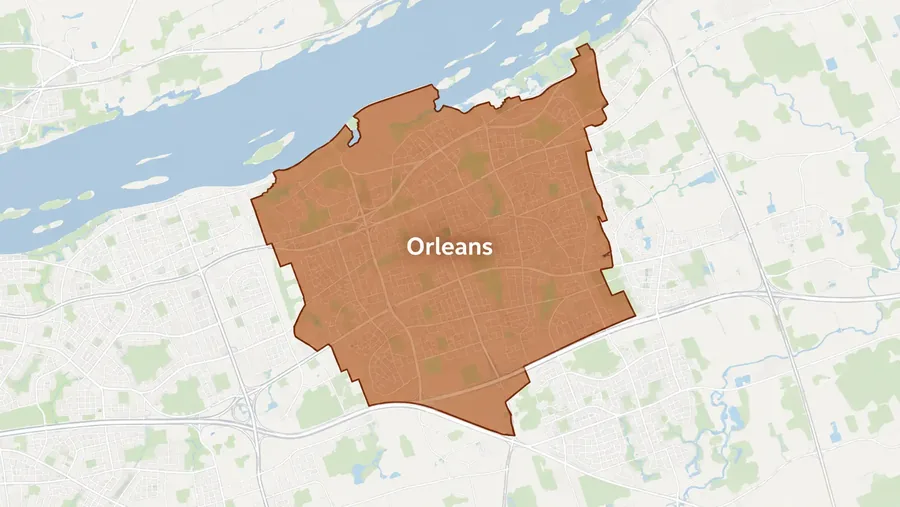
Orleans spans Orleans East-Cumberland, Orleans West-Innes and Orleans South-Navan. All three are in the City of Ottawa, so the same regulations apply across all of them.
Access By-law 2026-139 came into effect on 8 April 2026, replacing Private Approach By-law 2003-447, and Zoning By-law 2026-50 was enacted on 11 March 2026. A private approach must be between 2.4 m and 9.0 m wide and cannot exceed 50 percent of the lot frontage. Maximum driveway width is 6 m in Zones A to C and 50 percent of lot width in Zones D to F. At least half the front lawn must remain soft landscaping, and artificial turf does not count. Since 1 March 2026 a Hardscaping Contractor Licence has been mandatory in Ottawa.
Any workmanship warranty is set out in your written quote, job by job. Call (343) 314-8525.
Orleans driveway questions
Why do Orleans driveways look worst in March?
Because March is the thaw. Water that froze in the base through January and February expands, lifts the surface and opens cracks, then the ground softens as it melts and the lifted sections drop unevenly. What you are looking at in March is a winter's worth of damage arriving at once. It is also the month nobody can pave, because seasonal load restrictions of roughly 5 tonnes per axle run from early March to mid May and asphalt plants are still closed.
Our Orleans driveway has a hump near the garage. What causes that?
Usually frost heave from water trapped in the base, often where the driveway meets the garage slab and the grade does not carry water away. Sometimes it is a downspout discharging onto the driveway. Resurfacing over a hump reproduces the hump, because the surface is following the base. The fix is under the asphalt, and drainage work in Ottawa typically runs $1,000 to $3,000 depending on what is needed.
Which Orleans ward do we fall under for a City access permit?
Orleans covers three wards: Orleans East-Cumberland, Orleans West-Innes and Orleans South-Navan. The ward does not change the rules, because all three are inside the City of Ottawa. A residential access permit is $193, a culvert inspection is $112 where one applies, and processing takes six to eight weeks. Resurfacing an existing access at the same size needs no permit.
Does clay mean we need a deeper base in Orleans?
Sometimes, but depth alone is not the answer. Over soft ground the useful moves are reaching competent material, separating the granular from the subgrade with geotextile so the two do not mix, and compacting each lift properly. The City's light duty section is 50 mm of asphalt over 150 mm of Granular A and 300 mm of Granular B Type II at 98 percent Standard Proctor. We quote the depth we intend to build, in writing.
Price an Orleans driveway on what is actually under it
We walk the drainage, probe the base and put every depth in writing before you commit.