Rideau-Jock wardRural entrances and estate lotsFree written quotes
Driveway paving in Manotick, where the culvert is part of the job
Driveway paving in Manotick costs $5 to $10 per sq ft for new asphalt, $8 to $14 to remove and repave, and $2 to $5 for tar and chip or $1 to $4 for gravel on a long estate approach. On a rural entrance the culvert under the driveway has to meet City standard, and Paving Experts Ottawa prices it as part of the job.
Culvert sized and set to City standard for the entrance
Ditch left able to carry water, because owners may not alter ditches
Estate lot areas measured rather than estimated
Written quote itemised by depth, length and access work
Get a Manotick driveway quote
Tell us the approximate length and whether you cross a ditch.
Every quote is measured and priced on site.
What a rural entrance actually involves
The rules around ditches and culverts in Ottawa are specific, and most homeowners have never been told them.
The culvert is yours
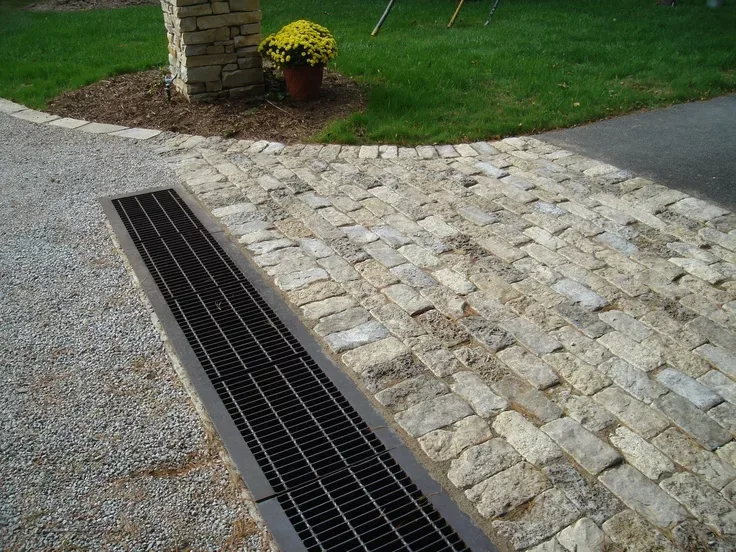
A driveway crossing a ditch needs a culvert built to City standard, and the homeowner owns and maintains it. That includes keeping it clear. It is not City infrastructure just because it sits at the road edge.
Ditches cannot be altered
Owners may not alter ditches. The ditch is part of a drainage system that serves the whole road, so filling, regrading or narrowing it is not permitted, and any entrance has to be designed around that.
Sized to a real standard
Ottawa sizes private access culverts for the 5-year storm, with overtopping not exceeding 0.3 m in the 100-year storm. That is a calculation, not a guess, and it is why culvert diameter is not a matter of preference.
Completed project
Recent Project in Manotick
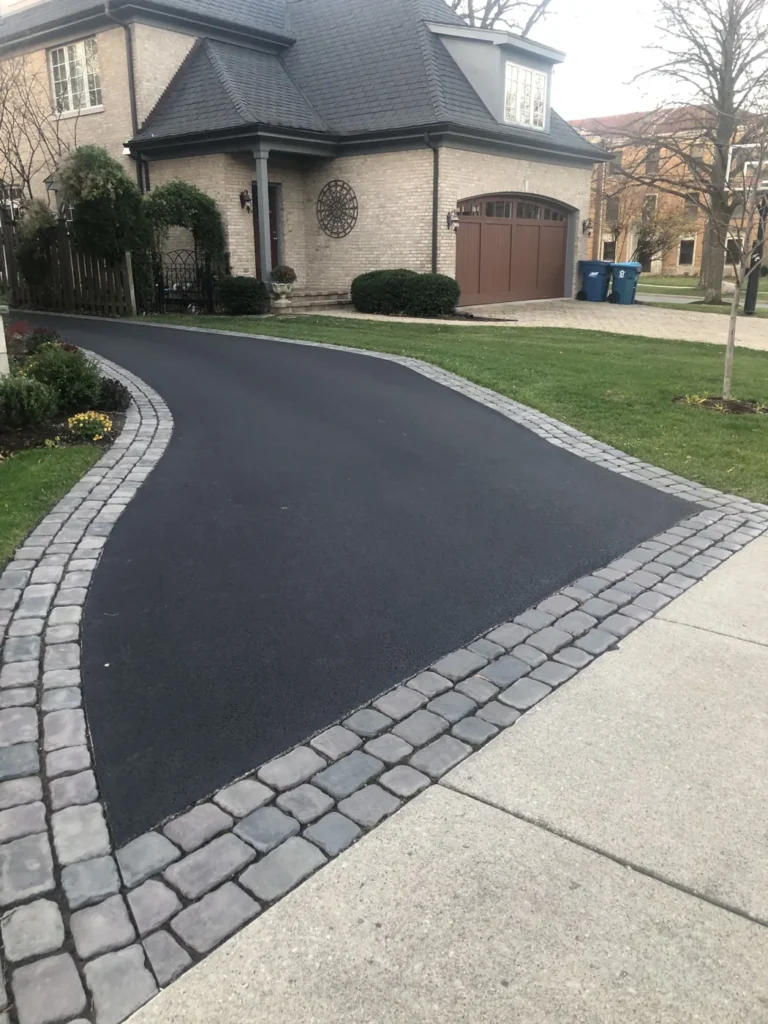
A new asphalt driveway laid in a sweeping curve from the street to the garage, edged on both sides with a double row of cobble-style interlock pavers. The paver border holds the asphalt edge in place, so it does not crumble where tires run off the side, and it gives the curve a finished line against the lawn and garden beds.
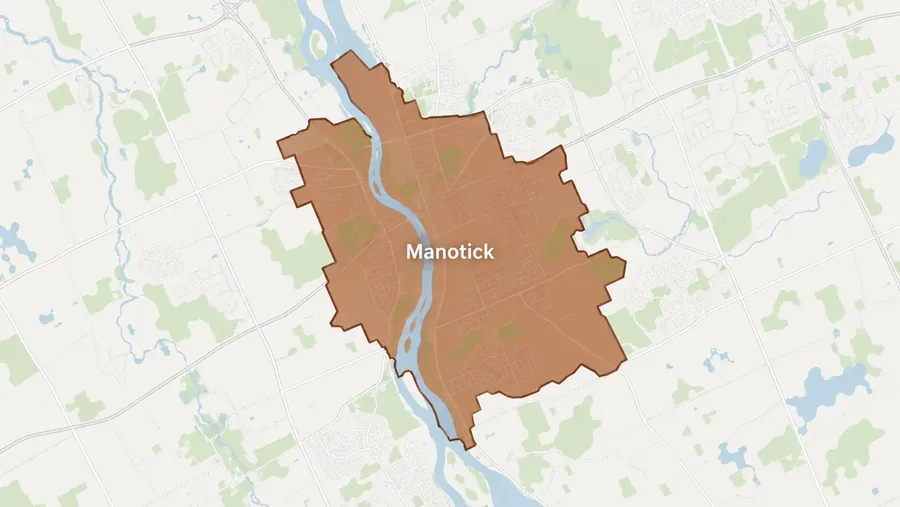
Manotick sits in the Rideau-Jock ward, which covers the former Rideau Township, with its village centre on the Rideau River. Outside that centre the area is largely rural and estate lots, and those two words change the job in every direction. Entrances cross ditches instead of meeting curbs. Driveways are long enough that material volume and haul become real line items. Lots are wide enough that the 50 percent of lot width limit in the rural zones is rarely the binding constraint. What binds instead is drainage: where water runs along the road, how the culvert carries it and how the driveway grade delivers water to the ditch rather than to the house.
The culvert rules on a Rideau-Jock entrance
A rural entrance is a drainage structure before it is a driving surface, and the rules around it are specific.
You own it, not the City
A driveway crossing a ditch needs a culvert built to City standard, and the homeowner owns and maintains it. Not the City, and not the road crew that plows past it every winter.
Sizing is set by two storms
Ottawa sizes private access culverts for the 5-year storm, with overtopping not exceeding 0.3 m in the 100-year storm. Those two conditions set the diameter. Whatever pipe happened to be on the truck is not a sizing method.
Culverts fail quietly
Silt builds at the invert, leaves pack the upstream end, ice forms in a partly blocked barrel over winter, and one spring the water backs up along the ditch and finds somewhere else to go. Usually a neighbour's frontage or your own lawn.
Budget the permit and the inspection
A culvert inspection costs $112 on top of the $193 residential access permit, and permit processing takes six to eight weeks. Plan the entrance well ahead of the season you want the work done in.
Ditches are not landscaping
Owners may not alter ditches, and that rule catches people constantly, because a ditch across a frontage is inconvenient and it looks like it belongs to the property it runs past. It does not function that way. A roadside ditch is part of a drainage system serving the entire road, and water from well beyond your frontage moves through it. Fill a section, narrow it, or flatten its profile to make a wider parking area, and the water that used to pass through has to go somewhere else. That is why the restriction exists, and why an entrance has to be designed around the ditch rather than through it. In practice this is less limiting than it sounds. The culvert carries the ditch under the entrance, and the approach grade is shaped so surface water from the driveway reaches the ditch rather than pooling or running back toward the house.
Our Process
How a Manotick job runs
1
Look at the road edge
We start where the driveway meets the road. Ditch line, existing culvert condition, invert level and how water currently moves along the frontage all get recorded before anything else.
2
Size the culvert
Where a culvert is needed or being replaced, it is sized to the City standard for the 5-year storm with overtopping limited to 0.3 m in the 100-year storm, and the permit and inspection are arranged.
3
Measure the full length
Estate driveways are longer than people estimate. We measure the actual area so the granular volume, the asphalt tonnage and the haul are priced on real numbers rather than a guess.
4
Build and grade to the ditch
Granular in compacted lifts, asphalt inside the temperature window, and a finished grade that sends water to the ditch and away from the foundation.
Surface options on a long Manotick approach
Rural and estate lots beyond the village centre produce driveways on a different scale from a suburban double, and the cost follows the area rather than the frontage.
Graded gravel
$1 to $4 per sq ft
Genuinely sensible on a long estate approach
Needs periodic grading and topping up
Crown or cross fall carries water to the ditch
Frees budget for the base, which is what lasts
Most popular
Tar and chip
$2 to $5 per sq ft
A bound surface, so it does not rut or migrate
Sheds water rather than holding it
Not as smooth as a well laid asphalt mat
Often used along the run with asphalt at the house
New asphalt
$5 to $10 per sq ft
Remove and repave $8 to $14, overlay $2.50 to $6
A double is 600 to 800 sq ft, a three-car 900 to 1,200
A rural approach passes both before it reaches the house
Interlock $20 to $35 and concrete $9 to $18 for comparison
Who owns the culvert under a Manotick driveway
The single most common surprise on a rural entrance job is ownership. A driveway crossing a ditch needs a culvert built to City standard, and the homeowner owns and maintains that culvert. Not the City. Not the road crew. The property owner.
That means keeping it clear is your responsibility, and so is replacing it when it fails. Ottawa does not leave the sizing to judgement either. Private access culverts are sized for the 5-year storm, with overtopping not exceeding 0.3 m in the 100-year storm, and those two numbers set the diameter.
Long Manotick estate laneways change the paving arithmetic
Manotick sits in the Rideau-Jock ward, covering the former Rideau Township, with its village centre on the Rideau River and largely rural and estate lots beyond it. Those lots produce driveways on a scale where the difference between an accurate measurement and a rough estimate becomes a large number.
Scale is also why other surfaces are worth discussing rather than dismissing. On a long rural approach, gravel and tar and chip deserve a conversation before anyone assumes asphalt is automatic. Season applies here as it does everywhere in Ottawa. Asphalt plants reopened in the first week of May in 2026, seasonal load restrictions of roughly 5 tonnes per axle typically run early March to mid May, and OPSS 310 requires 7 C and rising for a surface course with no paving on a frozen roadbed.
Any workmanship warranty is set out in your written quote, job by job. Call (343) 314-8525.
Manotick driveway questions
Who owns the culvert under a Manotick driveway?
You do. On a private access, the homeowner owns and maintains the culvert, including keeping it clear of silt, leaves and ice. People are frequently surprised by this because the culvert sits within the road allowance, but ownership of a private access culvert rests with the property. If it collapses or blocks, it is the property owner's responsibility to deal with.
Can we regrade the ditch along our Manotick road frontage?
No. Owners may not alter ditches. The ditch is part of a drainage system serving the whole road, so filling it, narrowing it or changing its profile is not permitted even where it would be convenient for a driveway layout. The entrance has to be designed around the ditch as it is, which in practice means the culvert and the approach grade do the work instead.
How is the culvert sized for a Manotick rural entrance?
By calculation against a storm standard, not by eye. Ottawa sizes private access culverts for the 5-year storm, with overtopping not exceeding 0.3 m in the 100-year storm. That determines the diameter and the invert level. A culvert inspection fee of $112 applies alongside the $193 residential access permit, and permit processing runs six to eight weeks.
Is the Rideau-Jock ward rural for driveway width limits?
For zoning purposes the rural and greenbelt zones use a different rule than the urban ones. Maximum driveway width is 6 m in Zones A to C, which are downtown and urban, and 50 percent of lot width in Zones D to F, which cover greenbelt, suburban and rural. On a wide estate lot that percentage rule is usually generous. The private approach itself must still be 2.4 m to 9.0 m wide and no more than 50 percent of lot frontage.
Price a Manotick driveway with the entrance included
We assess the ditch and culvert first, then measure and quote the driveway itself.