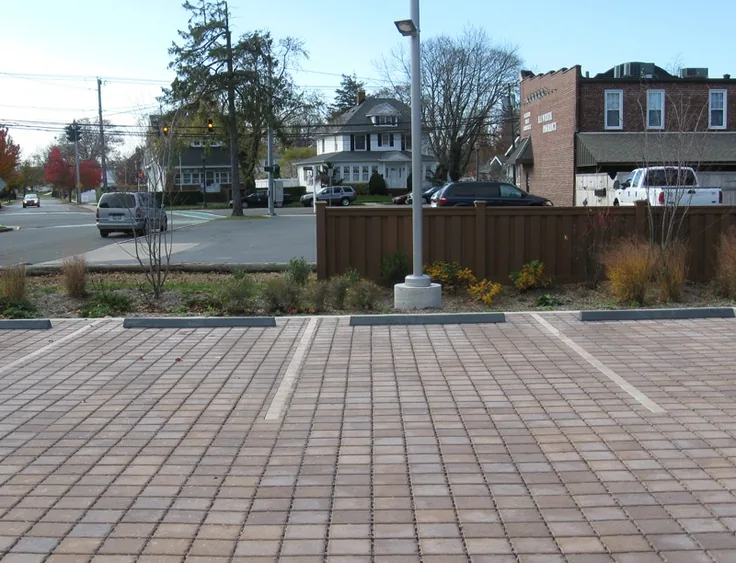
$20 to $35 per sq ft installedFrost depth basePermeable options permitted
Interlock driveways in Ottawa, and what the extra cost actually buys
An interlock driveway in Ottawa costs $20 to $35 per sq ft, commonly $8,000 to $18,000 for a double. Basic concrete pavers start at $18 to $22 and natural stone runs $35 to $50. Paving Experts Ottawa builds the compacted base that keeps the pavers level through the winters.
Excavation to frost depth, granular in compacted lifts
Edge restraint on every open side, not just the visible ones
Polymeric sand joints swept and set properly
Pavers lift and go back down when a repair is needed
Price an interlock driveway
Tell us the size and what is on the driveway now.
We will quote the asphalt alternative alongside it if you want the comparison.
The repair nobody can see afterwards
This is the argument for interlock on Ottawa clay, and it has nothing to do with appearance. Ground moves here. When a section of an asphalt driveway settles, the fix is to saw-cut it out and patch it, and that patch is a different colour and a visible joint for the rest of the driveway’s life. When a section of interlock settles, the pavers in that area come up by hand, the granular underneath is corrected and recompacted, and the same stones go back down in the same pattern. There is no seam, no colour mismatch and no patch, because no new material was introduced. The surface is made of parts. On a soil that moves as much as this one does, a surface built from parts you can take apart is worth something real.
Three things that decide whether it lasts
Pavers are the cheapest visible part of an interlock driveway. Everything that fails is underneath them.
Base depth and compaction
A driveway carrying vehicles needs a deeper granular section than a walkway, placed and compacted in lifts. On soft marine clay it also needs geotextile separating the subgrade from the clean stone so the two do not mix.
Edge restraint
An interlock field is held together by containment. Without a restraint anchored along every open edge, the outer pavers walk outward, the joints open and the field spreads. Most settled interlock starts as an edge failure.
Polymeric sand joints
Joint sand is structural. It transfers load between pavers, which is what interlocking means. Polymeric sand binds when wetted, resists washout and slows weeds, and it needs replacing periodically rather than never.
Our Process
How an interlock driveway gets built
1
Excavate deep enough to matter
Deep enough to place a proper granular section and get out from under the worst of the seasonal movement. On soft marine clay it goes deeper still, and geotextile goes between the subgrade and the clean stone so fines do not migrate up and clog the drainage.
2
Compact granular in lifts
Placed and compacted in layers, because a thick course dumped in one go compacts on the surface and stays loose underneath. A driveway base is not a patio base and the two get quoted very differently.
3
Screed a thin uniform bedding layer
The bedding course is not a levelling course. Using extra bedding sand to smooth out a poorly graded base builds a driveway that ruts in the wheel tracks, because bedding sand consolidates under repeated load.
4
Lay, restrain and sand
Pavers go down to the pattern, edge restraint is anchored along every open side including the ones facing a lawn, then polymeric sand is swept in, the field is plate compacted and the joints are wetted so the sand sets.
$20 to $35Per square foot installed across the Ottawa interlock market
50%Minimum share of a front yard the City requires to stay soft landscaping
65 to 85Sensitivity of Champlain Sea clay, the soil under much of the city
0.3 mClearance the City requires between a driveway and the neighbouring property line
Permeable pavers and the front yard arithmetic
The City of Ottawa names permeable pavement and honeycomb or turf blocks among the surfaces acceptable for a private driveway, alongside asphalt and cement. The Access By-law explicitly permits permeable surfaces so that stormwater can be absorbed on site rather than shed to the street. That matters more than it sounds, because of a separate rule about front yards. At least 50 percent of a front lawn has to remain soft landscaping, and artificial turf does not count toward that figure. Combined driveway and walkway hard surface cannot exceed 50 percent of the total frontage, and a driveway must keep 0.3 metres clear of the neighbouring property line. Permeable interlock is one of the few ways to get more usable parking surface without arguing with those numbers, since the units let water through the joints into an open graded base rather than run it off. If you are close to the limit on frontage, raise it early, because it changes the base design as well as the surface.
Interlock cost in Ottawa
Installed prices including excavation, base and restraint. Four independent local firms overlap in the same band, which is a reasonable sign the range is real.
Basic concrete pavers
$18 to $22 per sq ft
Standard rectangular or square units
Stock colours from current product lines
Full excavation and compacted granular base
Edge restraint and polymeric sand included
A double car driveway commonly $8,000 to $18,000
Pattern work, borders and soldier courses
Permeable units available and City accepted
Quoted by real measured area, not an estimate
There are three situations where we will tell you to spend the money somewhere else.
Long rural laneways
At $20 to $35 per square foot, a two hundred foot approach is a number nobody wants to read, and the aesthetic case for pavers weakens the further the surface sits from the house.
Steep grades
Water running down a paved surface concentrates at the joints, and on a slope the joint sand needs more attention over time. Ottawa's grading specification caps driveway grade at 6 percent in any case, but even inside that a steep interlock driveway is a maintenance commitment.
A budget that would come out of the base
If the savings would have to come from the excavation or the granular, asphalt built properly is a better driveway than interlock built badly. We will quote both if you want to see them side by side.
What to pin down before signing
How deep is the excavation
Ask for a number in millimetres and ask what happens if soft clay turns up at that depth. A driveway base is not a patio base and the two get quoted very differently.
What the edge restraint is
Ask what product, along which edges, and how it is anchored. An edge left unrestrained because it faces a lawn is the edge that fails first.
Whether the paver line is current
Product lines get discontinued. A driveway laid in a line that is being retired is harder to repair in ten years, and repairability was the reason to choose interlock.
What is written down
Any workmanship warranty is set out in your written quote, job by job. Settlement clauses in particular are worth reading before you sign rather than after something moves.
Repairability is what an interlock driveway actually buys you
Interlock costs roughly three times what asphalt costs per square foot. The usual justification is appearance, and appearance is a legitimate reason to spend money, but it is not the strongest argument on Ottawa soil.
The strongest argument is what happens when the ground moves. It will move. Champlain Sea clay underlies much of this region, its sensitivity runs between 65 and 85, and its natural water content of 64 percent sits above its liquid limit of 52 percent. It classifies as CH, high plasticity clay, which is the worst category on the frost susceptibility list.
When an asphalt driveway settles, the repair is a saw-cut patch, and even done properly that patch is a rectangle of newer, darker material with a visible joint around it for the rest of the driveway's life. When an interlock driveway settles, the pavers over the affected area come up by hand, the granular beneath is corrected and recompacted, and the same stones go back down in the same pattern. There is no seam and no colour mismatch, because nothing new was added.
The three layers under an interlock driveway
The pavers themselves are a commodity. They are manufactured to tight tolerances, they arrive on a pallet, and one contractor's paver is much like another's. Everything that separates a driveway that holds its line from one that ripples and settles is in the three layers below.
Edge restraint is the part most often skimped. An interlock surface works by transferring load sideways between units, and that only happens while the field is contained. Let the perimeter walk outward by ten millimetres and the joints open right across the driveway.
Any workmanship warranty is set out in your written quote, job by job. Call (343) 314-8525.
Interlock driveway questions
What does an interlock driveway cost in Ottawa?
Installed prices run about $20 to $35 per square foot. Basic concrete pavers sit at roughly $18 to $22 and natural stone starts around $35 and climbs past $50. A typical double car interlock driveway lands between $8,000 and $18,000 depending on size, pattern complexity and what has to be removed first.
How deep does the base go under a driveway?
Deeper than most people expect and considerably deeper than a patio. The base has to get below the reach of seasonal frost movement and carry vehicle loads, which means excavating well past the bedding layer and compacting granular in lifts rather than dumping it. Over soft Champlain Sea clay it goes deeper again, with geotextile between the clay and the stone.
What is polymeric sand and why does it matter?
It is joint sand with a binder in it that sets when the joints are wetted after sweeping. It holds the joint together, transfers load from one paver to the next and resists being washed out by rain or a pressure washer. Plain sand washes out, the joints open and the field loses its interlock. Joint sand is consumable and gets topped up over the years.
Do interlock driveways heave in Ottawa winters?
A badly built one does, the same as any surface here. Frost damage needs frost susceptible soil, freezing temperatures and available water at the same time, and the first two are fixed in this city. The base is where the third one gets controlled. The difference with interlock is that when a section does move, it can be lifted, corrected and reset with the same stone.
Can an interlock driveway be ploughed?
Yes, with a plastic or rubber edged blade rather than steel, and with the operator told the surface is pavers. A steel blade dropped on a laid field chips the leading edges and can catch a slightly proud unit. Sand and grit are fine. Heavy use of rock salt is worth avoiding on any hardscape here.
Get an interlock driveway priced properly
We measure the real area, check what the subgrade is and quote the base as its own line rather than burying it.