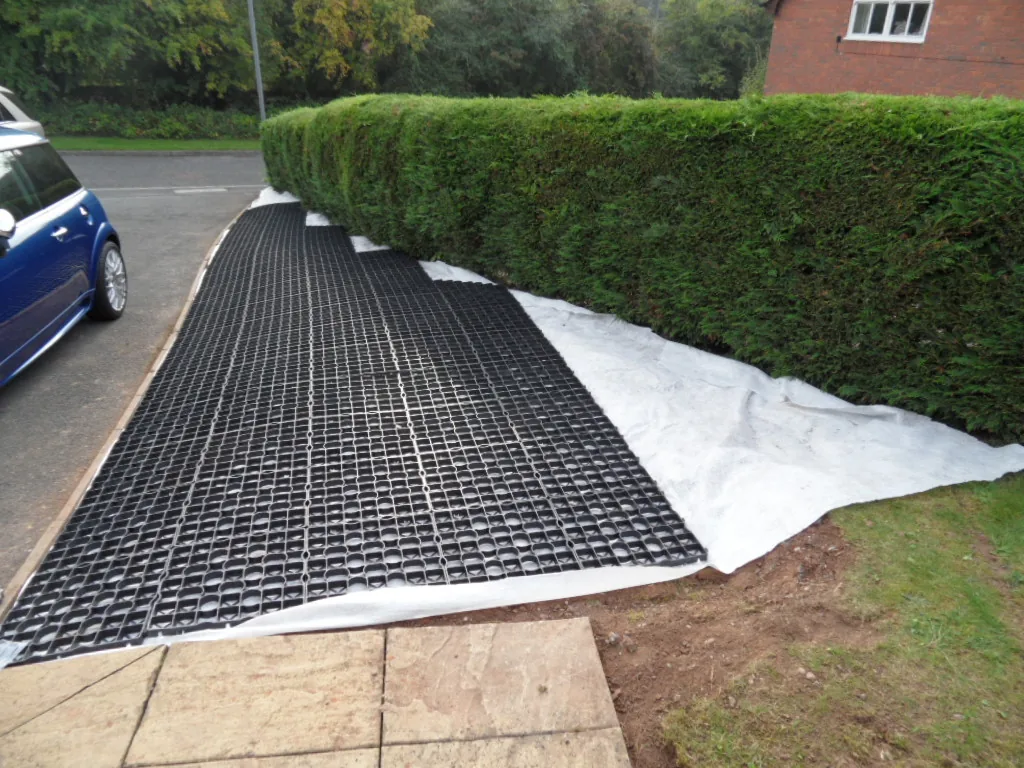
$1 to $4 per sq ft for surface gravelGeotextile over soft clayRural laneways and short drives
Gravel driveways in Ottawa, built to drain and stay put
A gravel top-up in Ottawa costs $1 to $4 per sq ft, roughly $400 to $1,600 for a 400 sq ft two-car area, and a heavier crushed stone build-up runs $2 to $5 per sq ft. Paving Experts Ottawa lays a separation layer so the stone does not sink into the clay.
Geotextile between soft subgrade and clean stone
Edging so the shoulder stops migrating into the lawn
Crown and fall set so water leaves the surface
Haul distance confirmed against a live pit quote before pricing
Price a gravel driveway
Tell us the length, the width and what is there now.
We will tell you whether you need a top-up or a rebuild.
The layer nobody sees is the one doing the work
Clean crushed stone drains. Ottawa clay does not. Put one straight on top of the other and traffic loads push the stone down into the soft subgrade while the clay works its way up between the aggregate. Within two seasons the granular is contaminated with fines, it stops draining, water sits in it, and ruts form exactly where the tyres run. The owner concludes that gravel does not work in this climate. What actually failed was the absence of a separation layer. A woven geotextile laid on the prepared subgrade before any stone goes down keeps the two materials apart permanently. The stone stays clean, the voids stay open, and water moves through the structure instead of being trapped in it. On soft marine clay it also spreads load, which means you need less stone depth to carry the same traffic. It is the cheapest item on the quote and the one most often left off.
Three things that decide whether gravel lasts
None of them are the gravel itself. All three are usually where a cheap quote saves its money.
Separation
Geotextile between soft subgrade and clean stone. Without it the stone migrates down, the clay migrates up, and the granular stops draining. This is the single difference between a laneway that lasts and one that ruts.
Edge restraint
Loose stone moves sideways under every turn. Timber, steel or a formed shoulder holds the running surface in place. Without edging you lose material into the lawn every year and pay to replace it.
Crown and fall
A gravel surface sheds water or it holds it. We set a crown across the running width and positive fall toward the ditch or road edge so meltwater leaves rather than soaking into the base.
$1 to $4Per square foot for surface gravel across Canadian markets
$2 to $5Per square foot for a heavier crushed stone section
$400 to $1,600Surface material on a 400 sq ft two-car area
Per projectHow a full excavate and build is quoted, because haul distance decides it
What gravel actually costs
Canadian ranges for the surface material and placement. Excavation, removal of an old surface, drainage work and any permits are quoted separately, not folded into a per square foot number.
Most popular
Re-gravel or top-up
$1 to $4 per sq ft
Existing structure is sound
Fresh wearing course placed and graded
A 400 sq ft two-car area runs roughly $400 to $1,600
Surface material only, no excavation
Dig out to real depth, geotextile, granular in lifts
Old surface removed and hauled
Drainage correction where the grade is wrong
Costs considerably more than a re-gravel and the quote will say so
Before any number goes on paper we price the stone against a live quote from the pit that will actually supply it, because the distance from that pit to your property moves the total more than the stone does.
2
Strip and shape the subgrade
Topsoil and organics come off, the subgrade gets shaped to the finished profile, and soft spots get dug out rather than bridged over with extra stone.
3
Lay geotextile and stone
Fabric goes down over soft clay, then granular in compacted lifts rather than one deep dumped layer. Each lift gets rolled before the next one goes on.
4
Crown, edge and hand over
We set the crown and fall, install edge restraint where the shoulder needs holding, and walk the finished profile with you so you know where water is meant to go.
Questions worth asking about a gravel quote
Is this a top-up or a build?
A $1 to $4 per square foot figure is a re-gravel. A full excavate and build costs considerably more. If the quote does not say which one it is, you cannot compare it with anything.
Where is the stone coming from?
Haul distance is the dominant cost on a rural Ottawa gravel job. A pit twenty minutes further away changes the delivered price of every tonne on the site.
Is geotextile included?
On soft clay it is the item that decides whether the laneway still drains in five years. Ask whether it is in the price or an extra.
What is the warranty position?
Any workmanship warranty is set out in your written quote, job by job. A loose surface is a maintained surface, and the quote should be honest about that.
Re-gravel or rebuild, and why the quote must say which
A top-up is not a build
A $1 to $4 per square foot figure describes placing a wearing course on a structure that is already there. It does not describe stripping topsoil, digging to a real depth, laying fabric and placing granular in lifts.
Excavation and removal are their own lines
Digging out, hauling an old surface away and correcting the grade are distinct scopes. Any of them can be needed on your site and none of them sit inside a per square foot surface rate.
A build priced as a top-up looks like a bargain
Right up until the extras arrive. We label which of the two jobs we are quoting, in writing, and itemise excavation, removal, drainage and any permits separately rather than hiding them in a rate.
Drainage gets its own number
A gravel surface that holds water is a grading problem rather than a stone problem. Folding that correction into a square foot figure tells you nothing about whether it is actually being done.
Gravel is an engineered surface, not a default
Gravel gets treated as the thing you settle for when asphalt is out of reach. That is a misreading of what it is. A gravel laneway built properly is a drainage structure with a wearing course on top, and on a long rural approach it can outperform a thin asphalt mat laid on the same ground for a fraction of the money.
The failure most people have seen is not gravel failing. It is stone dumped on clay. Within two seasons the aggregate has worked down into the soft subgrade, clay has worked up into the voids, the surface holds water instead of shedding it, and ruts form where the tyres run. Build it as a structure instead, with the subgrade shaped, the clay separated from the stone, the granular placed in compacted lifts and the edges restrained, and the behaviour changes completely. It is also the only surface on this site you can add to a bit at a time rather than replacing.
Why haul distance from the pit sets a gravel driveway price
Aggregate is heavy and low value per tonne, which means the cost of moving it is a large share of what you pay for it. On a rural Ottawa property, haul distance from the pit is the dominant cost on a gravel job. Not the stone. Not the labour. The trucking.
A property twenty minutes further from the supplying pit pays more for every tonne that lands on it, and a long laneway needs a lot of tonnes. That is why two gravel quotes for identical driveways in different parts of the region can be far apart without either contractor being unreasonable.
It is also why we do not publish a delivered per tonne rate. We have not verified a current Ottawa-area figure that would hold across the properties we work on, and quoting one anyway would be a number with no site behind it. What we do instead is confirm the rate against a live quote from the pit that will actually supply your job, then price from that.
Any workmanship warranty is set out in your written quote, job by job. Call (343) 314-8525.
Gravel driveway questions
How long does a gravel driveway last in Ottawa?
A properly built one lasts indefinitely because it is maintained rather than replaced. The wearing course needs topping up and regrading periodically, typically every few years depending on traffic and how hard the winter was. What does not last is stone laid directly on clay with no separation and no edge restraint, which can rut inside two seasons.
Does a gravel driveway need geotextile?
Over firm sand or competent granular subgrade, not necessarily. Over the soft marine clay that underlies much of this region, yes. It is what stops the stone mixing into the subgrade, and it is what keeps a gravel laneway draining. It also lets you carry the same load on less stone depth, which often pays for itself.
Why can you not quote gravel by the tonne over the phone?
Because haul distance dominates the delivered cost and it is specific to your site and the pit that serves it. We confirm the rate against a live pit quote rather than publishing a number that would be wrong for half the properties we work on. Quoting a tonne rate we have not confirmed would just be a guess with a decimal point in it.
What stone size should the top layer be?
The running surface wants a well graded crushed material with enough fines to lock together under traffic, not clean round stone that rolls. Larger clean stone belongs lower in the structure where its job is drainage. Getting this backwards produces a surface that never firms up and throws stone every time a car turns.
Can you convert a gravel driveway to asphalt later?
Often yes, and a well built gravel structure is a genuine head start because the granular base is already there and already compacted. We would probe it, check the depth and the grade, and tell you honestly whether it can be paved over or whether it needs correcting first. A gravel surface built on clay with no separation is not a base you would pave on.
Get your gravel driveway priced properly
We measure the run, check the subgrade and confirm the haul before quoting.