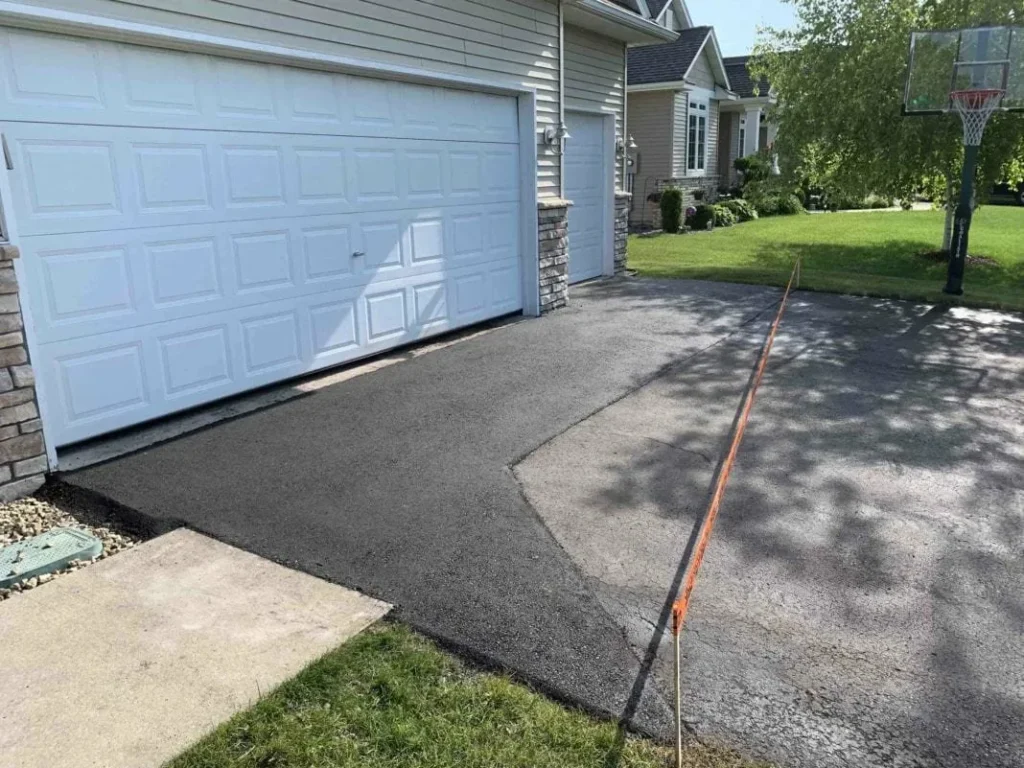
Full-depth saw-cut patchingBase failure identified before quotingObjective repair thresholds
Parking lot repair in Ottawa, measured against objective thresholds
Parking lot repair in Ottawa is one of three jobs, each priced after a written walk-round: full-depth saw-cut patching where the base has failed, surface repair where it is sound, or hazard repair around catch basins and raised edges. Paving Experts Ottawa uses permanent hot mix, not cold patch.
Full-depth saw-cut patching where the base has gone
Surface repair only where the structure underneath is sound
Trip hazards and defects identified on a written walk-round
Permanent hot mix repairs, not cold patch left as the answer
Book a lot inspection
Tell us the property and roughly how much of the surface is affected.
We will tell you if a repair is not worth doing.
8 cmPothole depth that triggers repair under the Ontario maintenance standards
5 cmSurface discontinuity that triggers repair on every road class
300 mmStep key required on all sides of a repaired road cut in Ottawa
106,350Potholes the City filled with cold patch over the 2025-26 winter
Three repairs, three different problems
Choosing the wrong one is how a lot gets repaired twice in three years.
Full-depth saw-cut patch
Where the base has failed. The failed area is saw cut to square edges, excavated through the asphalt and into the granular, the base is corrected and compacted, then new hot mix goes back in lifts. The only repair that fixes the cause.
Surface repair
Where the structure underneath is still sound and only the wearing surface has gone. Crack sealing, localised skin patching or an overlay. Much cheaper, and completely wasted if the base is the actual problem.
Hazard remediation
Raised edges, settled sections around catch basins and broken pavement at accessible stalls. These get prioritised ahead of cosmetic work because they are the defects that hurt someone.
What cold patch is actually for
Over the 2025-26 winter the City of Ottawa filled more than 106,350 potholes with cold patch, and it describes the material honestly in its own communications: useful because it can be applied in cold temperatures, but a generally temporary repair that does not bond strongly and can loosen again under traffic, particularly in wet weather and repeated freeze-thaw. That is the correct use for it. Cold patch is a safety measure that gets a hole out of service until a permanent repair is possible. It is not a repair strategy for a private lot, and a contractor who fills your potholes with it in November and invoices it as completed work has sold you a winter, not a fix. When asphalt plants reopen, usually the first week of May in this region, the same holes need cutting out and doing properly in hot mix. Paying twice is the predictable outcome of treating the temporary option as the permanent one.
Our Process
How we assess and repair a lot
1
Walk it and write it down
We map the defects, measure the significant ones, separate base failure from surface wear, and flag anything that is a trip hazard now rather than a maintenance item for later.
2
Sound and probe the failures
Alligator cracked and depressed areas get probed to find out how far the failure extends. The patch has to reach sound material, and the edge of the failure is rarely where the cracking stops.
3
Saw cut square and excavate
Failed areas are saw cut to straight vertical edges, then excavated through the asphalt and into the granular. Square edges are what let the new material compact against something solid.
4
Correct the base and reinstate
Granular corrected and compacted, then hot mix placed in lifts and rolled. Edges are sealed so water cannot get back in around the joint.
How to read a repair quote
Ask whether it is full depth or surface
Those are different jobs with different prices and different lifespans. A quote that just says repair potholes has not told you which one you are buying.
Ask what happens to alligator cracked areas
If the answer is fill them, the quote is wrong. Interconnected cracking means the base has failed and the area needs cutting out, not sealing over.
Ask whether cold patch is being used
It is the right answer in February and the wrong answer in July. If cold patch appears on a summer quote, ask why the work is not being done in hot mix.
Ask what the warranty position is
Any workmanship warranty is set out in your written quote, job by job. Get the repair type named per area rather than one lump sum for the site.
What the City's road cut policy says a good patch looks like
A 300 mm step key on all sides
The reinstatement is cut back beyond the excavation on every edge so the new surface course laps onto sound existing pavement instead of meeting it at the same line as the base repair. That staggered joint is what stops the edge of a patch becoming the next crack.
Square saw cut edges, not broken ones
Straight vertical faces are what let the new material compact against something solid. A jagged edge left by breaking out fails first, which is why so many patches crack around their own perimeter within a season.
Full-lane resurfacing on young pavement
The policy requires it where the pavement being cut is 3 years old or less. The reasoning transfers to a lot: a thin remnant strip of old material beside a new patch is simply the next thing to fail.
No narrow ribbon along the curb
Where a cut falls within 1 metre of the curb, the resurfacing has to extend all the way to the curb line. On a lot, a strip of old pavement left between the patch and the edge is a new weak point at exactly the place where water collects.
+15%Freeze-thaw cycling the City projects by the 2030s
+35%Freeze-thaw cycling projected by the 2050s
115 to 72Snow cover days now and as projected, meaning more bare pavement cycling across zero
1 metreDistance from the curb inside which resurfacing must run to the curb line
Provincial thresholds for ranking parking lot repairs
One of the hardest things about maintaining a parking lot is knowing when a defect has become a problem. Everything looks tolerable until somebody falls, and there is no obvious line in between.
Ontario Regulation 239/02, the Minimum Maintenance Standards for municipal highways, draws that line for public roads. We are presenting the numbers honestly as what they are: municipal road standards, adopted here as the best objective thresholds available rather than as a legal duty that applies to a private lot.
On a paved roadway, a pothole becomes actionable at 600 to 800 square centimetres of surface area combined with 8 centimetres of depth on Class 1 and Class 2 roads, and the repair window is 4 days. On Class 3 to Class 5 roads the trigger is 1,000 square centimetres and 8 centimetres deep, with repair windows of 7, 14 and 30 days depending on the class. A surface discontinuity of 5 centimetres triggers repair across every class, and within 2 days on Class 1 and 2.
Apply those numbers to your own lot and a vague worry turns into a list. A 5 centimetre step anywhere someone walks is the defect to fix first, ahead of anything cosmetic.
Interconnected cracking means a full-depth parking lot repair
The most consequential diagnosis on a lot is whether an area has failed at the surface or failed underneath, because the two look similar from a car and need completely different work.
Surface failure is fading, isolated linear cracks, ravelling at the edges, and a pavement that is firm everywhere you step. Structural failure is alligator cracking: interconnected cracks that have broken the surface into plates, usually with a slight depression and sometimes movement underfoot. Water has been getting into the granular, freezing, expanding, and destroying the base's ability to carry load.
You cannot fill that. The only repair that addresses the cause is a full-depth patch, saw cut to square vertical edges and excavated into the granular. The extent matters too, because alligator cracking almost never stops where it is visible, and a patch that stops at the visible edge has been placed on the failure it was meant to remove.
Any workmanship warranty is set out in your written quote, job by job. Call (343) 314-8525.
Parking lot repair questions
When does a pothole in my lot need repairing?
There is no legal threshold for a private lot, but Ontario's Minimum Maintenance Standards for municipal roads give you the best objective numbers available. On a paved roadway a pothole becomes actionable at 600 to 800 square centimetres of surface area and 8 centimetres deep on Class 1 and 2 roads, with repair required within 4 days, and at 1,000 square centimetres and 8 centimetres on Class 3 to 5 roads, with 7, 14 and 30 day windows. A surface discontinuity of 5 centimetres triggers repair on every class, within 2 days on Class 1 and 2. Those are road standards, not a duty that applies to you, but they are a defensible yardstick for deciding what is urgent.
Is a patch or a full resurface the right call?
It depends on how much of the lot has base failure and where it is. Scattered full-depth patches across an otherwise sound lot are good value. Once base failure is widespread, patching becomes a series of payments toward a rebuild you are going to do anyway. We map the failed areas first and give you the percentage, because that number is what makes the decision rather than an opinion about it.
Why did the patch we had done last year fail?
Three common reasons. It was cold patch, which is temporary by design. Or the repair was surface only over a base that had already failed, so the same movement came straight back through. Or the excavation stopped at the visible edge of the cracking instead of reaching sound material, and the patch edge failed first. Square saw cut edges into sound pavement are not a detail, they are what makes the repair last.
Am I liable for a trip hazard in my parking lot?
Property owners are responsible for the condition of their own surfaces, and we are not in a position to give you legal advice about your specific situation. What we can do is identify the defects on a written walk-round, measure the significant ones, and prioritise the ones that present a hazard rather than the ones that look worst from the road. Raised edges, settled areas around catch basins and broken pavement at accessible stalls get dealt with first.
Can you repair a lot in winter?
We can make it safe in winter. Permanent hot mix repairs need the plants open, which in this region generally means early May to mid October, and they need the temperature conditions the Ontario specification sets out. Between those seasons a hazardous hole can be filled as a temporary measure and cut out properly once the season opens. We will say plainly which one you are getting.
Get your lot assessed before the next thaw
A written walk-round separating base failure from surface wear, with the repair type named per area.