Ottawa ward Riverside South-Findlay CreekWater table 0.7 to 1.3 mDrainage first
Driveway paving in Riverside South, built over a high water table
Driveway work in Riverside South runs $200 to $500 for a crack repair visit and $2.50 to $6 per sq ft to resurface a driveway with a sound base. With the water table under a metre down in places, Paving Experts Ottawa checks drainage and the base before quoting any new surface.
Granular depth set by the ground, not by a template
Fall to the road checked before anything is ordered
Soft spots probed at the garage apron and the road edge
Written quote itemised by depth and by area
Get a Riverside South quote
Tell us the size and what is there now.
Every quote is site specific.
What the ground under Riverside South is doing
These figures come from geotechnical work reviewed by the City for this community. They are the reason drainage is the first conversation, not the last.
Groundwater 0.7 to 1.3 m down
That is shallower than most people expect anywhere, let alone in a suburb built in the last twenty years. A base that traps water sits inside the frost zone all winter, and frost damage needs only susceptible soil, cold and water at the same time.
A weathered crust 0.8 to 2.7 m thick
The stiff upper clay crust varies by roughly two metres across the community. Two neighbours can have very different support under the same driveway width, which is why we probe rather than assume.
Bedrock from about 5 to 25 m
Bedrock is deep through most of Riverside South and as shallow as roughly 2 m in the south and east portions. Neither extreme helps a driveway. What helps is granular that drains and a surface that sheds water to the road.
Completed project
Recent Project in Riverside South
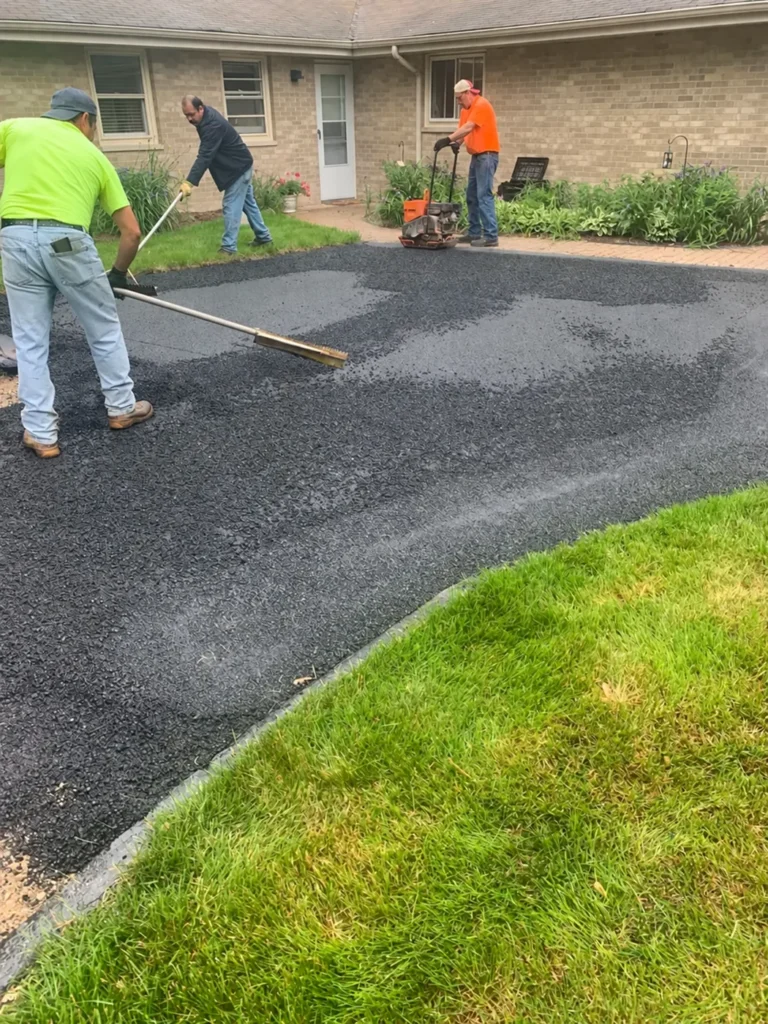
A driveway being paved with fresh asphalt. The crew is raking the hot mix to an even depth along the lawn edge while a plate compactor works the area near the house. Getting the material spread and compacted while it is still hot is what gives the finished driveway its density, so the raking and compaction happen in the same pass.
0.7 to 1.3 mMeasured groundwater depth below ground surface
5 to 25 mDepth to bedrock, and about 2 m in the south and east
0.8 to 2.7 mThickness of the weathered clay crust
2.4 mMinimum depth City watermains sit below grade
Why a new suburb still needs a serious base
Riverside South sits in the Riverside South-Findlay Creek ward, inside the City of Ottawa, so Ottawa entrance rules apply here in full. What makes the area unusual is the ground. A geotechnical study reviewed by the City found groundwater between 0.7 and 1.3 m below surface, a weathered clay crust between 0.8 and 2.7 m thick, and bedrock ranging from about 5 to 25 m deep. The same report recommended 90 mm of asphalt over 150 mm of Granular A and 375 mm of Granular B Type II for local roads with no bus or truck traffic, rising to 450 mm of Granular B on collectors. A driveway carries far less load, but the drainage job the granular does is identical.
Depth is not decoration
The geotechnical study reviewed by the City for this community is specific. For local roads carrying no bus or truck traffic it recommends 90 mm of asphalt over 150 mm of Granular A and 375 mm of Granular B Type II, and for collectors the Granular B goes to 450 mm. The same report specifies 1.5 m of earth cover over exterior perimeter foundation elements for frost protection. Those are not driveway numbers, and a driveway is a much lighter structure than a road. They are useful anyway, because they tell you how deep the engineers working here think frost reaches. The granular layer under a driveway is doing exactly the same job it does under a road, and that job is mostly drainage. So when a quote names an asphalt thickness and says nothing about granular depth or grade, it has described the least important layer.
Our Process
How a Riverside South job runs
1
Probe and measure
We measure the real area, check the fall from the road edge to the garage and probe the existing base for soft spots and standing water.
2
Set the drainage line
Before any depth is quoted we decide where water leaves the driveway. On flat suburban lots that often means correcting grade rather than adding asphalt.
3
Build in lifts
Granular goes in and gets compacted in layers, not dumped in one pass. Over soft clay this is where geotextile goes in, and it is the step you never see again.
4
Pave and hand over
Mix is placed and rolled inside the compaction window, edges are hand worked, and we walk the drainage with you before we leave.
What we establish before pricing a Riverside South driveway
The ground here is documented, and the documentation is the reason we probe rather than quote from a street name.
How thick the weathered crust is on your lot
It runs between 0.8 and 2.7 m across this community. That is a two metre spread inside one neighbourhood, so two houses on the same street can sit on meaningfully different support.
Where the water table sits
Groundwater has been measured between 0.7 and 1.3 m below ground surface. That is close enough to the underside of a normal driveway build that drainage gets designed first and thickness second.
Which soil is actually under the lot
Much of this area of the city sits on Champlain Sea clay, which classifies as high plasticity CH clay, the worst category there is for frost susceptibility. We confirm it on site rather than assuming it from the address.
Where the surface water will go
On a flat suburban lot with a high water table, water pools anywhere the grade allows. Positive fall to the road, a grade not exceeding 6 percent and 150 mm of foundation clearance are the working numbers.
Riverside South looks like the easiest paving ground in the city. Flat lots, wide streets, houses built inside the last two decades. The ground underneath tells a different story, and it is documented in geotechnical work the City itself reviewed for this community.
Groundwater 0.7 m under Riverside South driveways
Groundwater in Riverside South has been measured between 0.7 and 1.3 m below the ground surface. That is shallow: the water responsible for frost heave already sits close to the underside of a normal driveway build, and has no distance to travel to reach the granular.
Frost damage is not mysterious. It needs three conditions present at the same time: a frost susceptible soil, sub-freezing temperature and available water. Remove any one and the damage is minimised. Ottawa gives you the first two at no charge, with a January mean of minus 10.0 C and a record low of minus 36.1 C. That leaves water, which is why here the drainage conversation happens before the thickness conversation.
New Riverside South, very old clay
The most common assumption we hear is that a newer house means a newer problem set. It does not. The Champlain Sea clay beneath it is roughly ten thousand years old and behaves the way it always has: sensitivity in the 65 to 85 range, natural water content near 64 percent against a liquid limit of 52 percent, and a very poor tolerance for repeated wetting and freezing.
Climate normals for 1991 to 2020 put annual snowfall at 231.9 cm and annual rainfall at 757.2 mm. All of that has to go somewhere. Practically, a Riverside South driveway is won or lost on three things: a granular base deep enough and clean enough to drain, a surface graded to move water to the road rather than toward the garage, and asphalt compacted properly while it is still hot.
Any workmanship warranty is set out in your written quote, job by job. Call (343) 314-8525.
Riverside South questions
Why does the water table matter for a Riverside South driveway?
Groundwater here has been measured at 0.7 to 1.3 m below the surface. Frost damage requires three things at once: frost susceptible soil, sub-freezing temperature and available water. In Riverside South the first two are given, so the only one you can control is water. A base that drains and a surface that sheds to the road are the whole strategy.
What base depth do you build in Riverside South?
It depends on what the probe finds. For reference, a geotechnical report reviewed by the City for this community recommends 150 mm of Granular A over 375 mm of Granular B Type II for local roads with no truck traffic. A residential driveway carries less load and rarely needs the full road section, but the number on your quote will be written down rather than described as adequate.
My Riverside South driveway came with the house. When is it due for replacement?
Look at the failure pattern rather than the age. Alligator cracking across the whole surface means the base has failed and an overlay will just repeat the crack pattern. Isolated cracks and a sound, even surface usually mean crack repair at $200 to $500 a visit, or a resurfacing at $2.50 to $6 per square foot. We will tell you which one the driveway actually is.
Do Ottawa entrance rules apply in Riverside South?
Yes. Riverside South is inside the City of Ottawa, in the Riverside South-Findlay Creek ward, so City access rules and the City permit process apply to a new or altered entrance. Repaving within the existing footprint is a different situation from widening or moving an entrance, and we will tell you which one your job is before you commit.
Price a Riverside South driveway
We measure, probe the base and put the granular depth in writing.