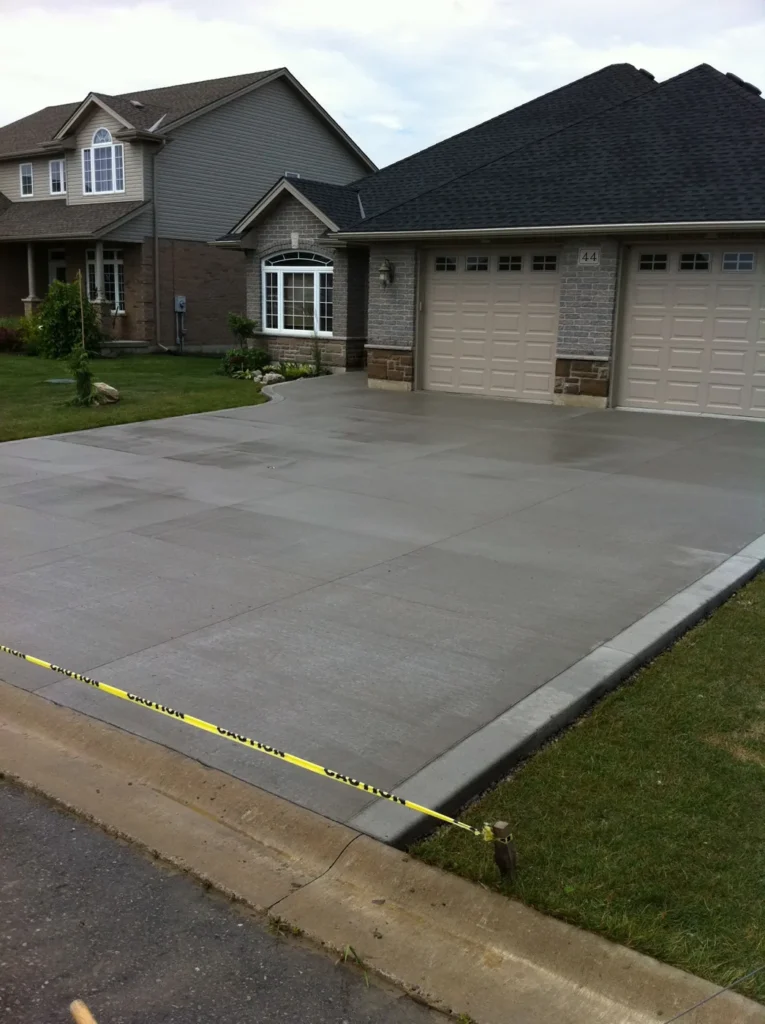
$9 to $18 per sq ft broom finishedAir entrained mixControl joints cut to plan
Concrete driveways in Ottawa, designed around salt and frost
A broom-finish concrete driveway in Ottawa costs $9 to $18 per sq ft, about $5,400 to $10,200 for a typical 600 sq ft driveway. Exposed aggregate runs $11 to $32 and stamped concrete $18 to $30. Paving Experts Ottawa designs the base and control joints for Ottawa salt and frost.
Air entrained mix, which is not optional in this climate
Control joints planned and cut before the slab decides
Granular base built to depth and compacted in lifts
Reinforcement quoted as its own line, not assumed
Price a concrete driveway
Tell us the size and what is on the driveway now.
We will be straight with you about how concrete ages here.
Three things a concrete driveway needs here
None of these are upgrades. In a climate with this much freeze-thaw and this much road salt they are the baseline.
Air entrainment
Microscopic air bubbles deliberately introduced into the mix give freezing water somewhere to expand into. Without them the water expands against the paste and breaks it apart from the inside. This is the single most important mix decision in Ottawa.
Control joints
Concrete shrinks as it cures and it cracks. Control joints are deliberate lines of weakness cut or tooled to depth so the crack happens where you put it. A slab without a joint plan cracks on its own schedule and in its own pattern.
A real base
Concrete is rigid, so it spans small soft spots until it does not, and then it cracks through. Granular has to go in to depth and be compacted in lifts, and on soft marine clay it needs geotextile separating clay from clean stone.
You decide where it cracks, or it decides
Concrete driveways crack. That is not a defect and no contractor can promise otherwise. Cement paste shrinks as it hydrates, the slab is restrained by friction against the base, and the tension has to go somewhere. Control joints are how that is managed. They are cut or tooled to roughly a quarter of the slab depth in a planned grid, creating lines of weakness so the shrinkage crack forms below the joint where it is invisible and where it can move without opening a jagged line across the surface. Joint spacing, joint depth and joint timing are all real decisions and they get made before the pour, not afterwards. Ask to see the joint layout on your quote. A contractor who has not thought about where the joints go has not thought about where the cracks go either.
Our Process
How a concrete driveway gets built
1
Excavate and build the base
Granular goes in to depth and is compacted in lifts. On soft marine clay, geotextile separates the clay from the clean stone. Concrete is rigid, so it spans small soft spots until it does not, and then it cracks through.
2
Set forms, grade and reinforcement
Grade is set so water leaves the slab. Ottawa's grading specification caps driveway grade at 6 percent, wants swales at no less than 1 percent, and asks for 150 mm of clearance between foundation and finished grade. Mesh or rebar is placed and quoted as its own line.
3
Pour an air entrained mix
Microscopic air bubbles deliberately introduced into the mix give freezing water somewhere to expand into. In this climate that is the baseline, not an upgrade, and it is the single most important mix decision.
4
Cut the joints and cure
Control joints are cut or tooled to roughly a quarter of the slab depth on the planned grid. Cut too shallow and the slab cracks somewhere else anyway. Cut too late and the crack has already formed.
3,500 mg/LPeak chloride measured in one Ottawa creek, against 120 mg/L considered safe for freshwater organisms
190,000 tRoad salt reported spread across the city in a single winter as of 2020
5+ yearsSensible resealing interval for concrete, against two to three years for asphalt
Salt scaling is what takes concrete apart here
Asphalt is largely indifferent to road salt. Concrete is not, and this is the specific reason concrete driveways in Ottawa look tired faster than the same driveways in a milder city. Chloride solution soaks into the surface pores. When it freezes, it does not freeze uniformly, and the pressure generated under partial freezing conditions is higher than with plain water. The paste at the surface fails first, so the driveway loses a thin layer, the aggregate is exposed, and the newly exposed surface is rougher and absorbs more solution than the last one did. It accelerates. Two things slow it down. An air entrained mix, which gives the freezing solution somewhere to expand into. And a penetrating sealer at $1 to $3 per square foot, reapplied at five year or longer intervals, which reduces how much solution gets in at all. A first winter with no de-icer on a new slab is worth more than either.
Why a rigid slab is less forgiving on this ground
This is not an argument against concrete. It is an argument for spending the money underneath.
The soil moves
Champlain Sea clay runs under much of the city. Its sensitivity sits between 65 and 85, its natural water content of 64 percent is above its liquid limit of 52 percent, and it classifies as CH, high plasticity clay, the worst category for frost susceptibility.
Concrete cannot flex with it
Asphalt deforms with small ground movement and usually survives. A slab spans a soft spot until the tension exceeds what it can carry, and then it cracks through, often in a place no joint was planned.
What actually helps
A properly excavated and compacted granular section, geotextile where soft clay is present, drainage that gets water away rather than letting it sit under the slab, and reinforcement at $0.50 to $2 per square foot to keep any crack that does form tight and in plane.
Concrete driveway costs in Ottawa
Installed ranges before removal of an existing surface. A typical 600 square foot plain driveway lands around $5,400 to $10,200.
Most popular
Plain broom finish
$9 to $18 per sq ft
Standard grey concrete, broom textured
Air entrained mix and planned control joints
Typical 600 sq ft driveway $5,400 to $10,200
Easiest finish to repair and to resurface later
Surface paste washed back to reveal the stone
Grip that holds up well in winter
Aggregate choice drives the price range
Sealing matters more than on a broom finish
Patterned and colour hardened surface
Complex custom work can run $30 to $45
More surface detail means more to maintain
Colour matching a later repair is difficult
Four things that should be on paper before a truck is booked.
Is the mix air entrained?
Without deliberate air, freezing water expands against the paste and breaks it apart from the inside. In a city that reported around 190,000 tonnes of salt across a single winter as of 2020, this is not a line to leave off.
Where do the joints go?
Ask to see the joint layout before the pour. Joint spacing, joint depth and the timing of the cut are all real decisions, and a contractor who has not thought about where the joints go has not thought about where the cracks go either.
How deep is the granular?
A number in millimetres, what material, and compacted to what. Ask what happens if soft clay turns up at that depth, because a rigid slab has no tolerance for a base that was guessed at.
Is reinforcement a separate line?
Mesh or rebar runs $0.50 to $2 per square foot and should appear on its own rather than being assumed either way. Any workmanship warranty is set out in your written quote, job by job.
Concrete will crack, the only question is where
Start here, because every honest conversation about a concrete driveway starts here. Concrete shrinks as it cures. The slab is held down by friction against the base beneath it. The shrinkage puts the slab in tension, and concrete has very little tensile strength. Something has to give.
Control joints are how a competent contractor decides that argument in advance. They are grooves cut or tooled into the slab to roughly a quarter of its depth in a planned grid, and they create a deliberate line of weakness. The shrinkage crack forms under the joint where nobody sees it, and the joint gives it somewhere to move without opening a ragged line across the surface. A concrete quote that does not mention joints has not been thought about.
It is also worth knowing that the City states plainly that pavement age is not a factor in assessing pavement performance. Condition is what matters, not the year it went in.
Broom, exposed aggregate or stamped concrete driveway finishes
Broom finish is the default and there is nothing wrong with that. It is the cheapest at $9 to $18 per square foot, it grips in winter, and it is the easiest surface to repair or resurface later.
Exposed aggregate at $11 to $32 per square foot washes the surface paste back to reveal the stone. It looks better than broom finish to most eyes and it grips well. Because more of the surface is open, sealing matters more.
Stamped concrete at $18 to $30 per square foot is patterned and colour hardened, with complex custom work reaching $30 to $45. It is the most striking option and the hardest to live with here, because the colour and pattern are effectively impossible to match if a section ever needs replacing.
Any workmanship warranty is set out in your written quote, job by job. Call (343) 314-8525.
Concrete driveway questions
What does a concrete driveway cost in Ottawa?
Plain broom finished concrete runs about $9 to $18 per square foot, which puts a typical 600 square foot driveway at roughly $5,400 to $10,200. Exposed aggregate runs $11 to $32 and stamped work $18 to $30, with complex custom stamping reaching $30 to $45. Reinforcement mesh or rebar adds $0.50 to $2 per square foot and sealing adds $1 to $3.
How long before I can drive on new concrete?
Considerably longer than asphalt. Foot traffic comes first, vehicles much later, and the exact timeline depends on the mix, the weather and the slab thickness. This is one of the real practical differences between the two surfaces and we give you the specific dates for your pour rather than a rule of thumb.
Do I need rebar or wire mesh?
Reinforcement does not stop concrete cracking. What it does is hold the two sides of a crack together and in plane, so a crack stays tight instead of opening and stepping. On a driveway carrying vehicles over clay that moves seasonally, that is worth having. It runs $0.50 to $2 per square foot and it should appear as its own line on the quote.
Can I use ice melter on a concrete driveway?
Sparingly, and not in the first winter. Chloride based de-icers drive salt scaling, which is the surface flaking that takes concrete driveways apart in this city. A new slab is at its most vulnerable before it has fully matured and been sealed. Sand for grip does the traction job without the chemistry.
How often should concrete be sealed?
At intervals of about five years or more, which is quite different from asphalt sealing at two to three. Sealing runs $1 to $3 per square foot. A penetrating sealer reduces how much chloride solution gets into the surface pores, which is the mechanism behind scaling. It is worth doing and it is not a cure for a poor mix.
Get a concrete driveway quoted honestly
Mix, base depth, joint layout and reinforcement itemised, so you can see what you are paying for and compare like with like.