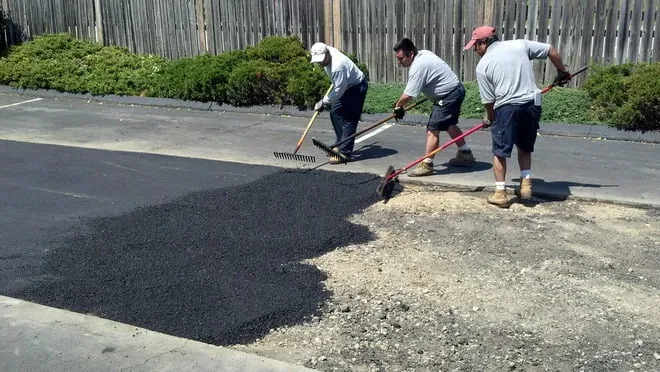
Moderate repairs $500 to $1,500Saw-cut full depth patchesHot mix, not cold patch
Driveway repair in Ottawa, patched properly or paid for twice
Driveway repair in Ottawa runs from a few hundred dollars for crack sealing and small patches to $500 to $1,500 for several full-depth patches, and $1,500 to $5,000 or more for partial reconstruction. Paving Experts Ottawa saw-cuts each patch to square edges so it keys into sound asphalt.
Square saw-cut edges, no feathered joints
Base corrected and compacted before the patch goes in
Cracks routed and sealed rather than smeared over
An honest read on whether a patch is still worth it
Get a repair quote
Tell us roughly how many problem areas there are and how big.
Some driveways are past repairing. We will say so.
600 cm2Pothole surface area that makes a defect actionable on a Class 1 or 2 road under Ontario Regulation 239/02
8 cmPothole depth at that same threshold, measured from the surrounding surface
5 cmSurface discontinuity that triggers a repair obligation on every road class
300 mmStep key the City of Ottawa requires on all sides of a resurfaced road cut
Three kinds of damage, three different repairs
The word repair covers jobs that share nothing but a name. What is wrong decides what gets done and what it costs.
Isolated cracks
Single cracks and block cracking get routed out to a clean reservoir and sealed with hot rubberised material. This is maintenance, it is cheap, and doing it on time is what keeps water out of the base.
Potholes and broken sections
Saw-cut square to sound asphalt, excavate the failed material, correct and compact the base, tack the vertical faces, fill with hot mix in lifts and compact. The edges are the repair.
Alligator cracking
Interconnected plates mean the base has lost bearing. There is nothing to fill. It takes a full depth patch of the whole affected area, or on a wide enough failure, a rebuild of that section.
Why a patch gets saw-cut and keyed in
A patch has two parts: the material in the middle and the joint at the edge. Almost every failed patch failed at the joint. The cheap method is to shovel material into the hole and feather the edges out over the surrounding asphalt so it looks smooth. That leaves a tapering wedge of new material a few millimetres thick at its outer edge, sitting on top of the old surface with no bond to speak of and no thickness to resist anything. A plough blade catches it. A tyre turning under power peels it. Two winters later the patch is a slightly different shaped hole. The correct method is to saw-cut a square perimeter back into asphalt that is still sound, so the new material meets the old at a full depth vertical face. Those faces get tacked, and the patch becomes a plug locked in on all four sides rather than a pancake laid on top. The City of Ottawa applies the same principle to utility cuts in its own roads, requiring a 300 millimetre step key on all sides of a repaired cut.
Our Process
How a patch is actually built
1
Measure the defect
Area and depth, and how far the failure runs past the visible edge. Damaged asphalt almost always extends further than the hole you can see, and cutting to the visible edge is why patches fail.
2
Saw-cut a square perimeter
Straight vertical faces cut back into sound material. A square cut gives the new asphalt something to lock against. A feathered edge gives it a thin wedge that ploughs and tyres peel off.
3
Fix what is under it
Excavate the failed material, find out why it failed, correct drainage or replace saturated granular, then compact in lifts. A patch over a wet base is a hole with a lid on it.
4
Tack, fill and compact
Vertical faces get tacked so the new material bonds to the old. Hot mix goes in slightly proud, gets compacted down flush and the joint gets sealed.
Cold patch is a winter stopgap and nothing more
Between roughly November and May, hot mix is not available and the ground is frozen, and cold patch fills that gap. The City of Ottawa filled over 106,350 potholes with it across the 2025 to 2026 winter and is candid about what it is: useful because it can be applied in cold conditions, but generally a temporary repair that does not bond strongly and can loosen again under traffic, particularly in wet weather and repeated freeze-thaw. That is the right way to think about it on a driveway too. If a hole opens in February and it is deep enough to damage a rim, fill it with cold patch, keep an eye on it, and book the real repair for the spring. Local plants reopened in the first week of May in 2026, and spring load restrictions of roughly 5 tonnes per axle run from early March to mid May, which is the other reason nobody starts driveway work in early spring.
Four questions worth asking about a repair quote
The word repair covers jobs that share nothing but a name, so the quote has to say which one you are buying.
Is the patch cut or feathered?
Ask directly. A saw-cut square perimeter with vertical faces is a different product from a feathered wedge, and the answer tells you what you are paying for. The City requires a 300 mm step key on its own road cuts for exactly this reason.
What happens under the patch?
Ask whether the failed material comes out, whether the base gets corrected, and whether the granular is compacted in lifts. A patch over a wet base is a hole with a lid on it.
How far past the visible edge does the cut go?
Damaged asphalt almost always extends further than the hole you can see. Cutting to the visible edge is the most common reason a repair reopens along its own joint.
Where is the line between repair and rebuild?
Roughly when repair cost passes about half the cost of replacing the driveway, or when failures keep appearing in new places. Any workmanship warranty is set out in your written quote, job by job.
What repairs cost in the Ottawa market
Ranges for residential work. The number depends on how much area is failing and whether the base underneath has to be corrected.
Crack sealing and small patching
From a few hundred dollars
Routing and hot rubberised sealant
Small isolated patches
Best value repair available on asphalt
Done before water gets into the base
Several saw-cut full depth patches
Base correction under the failed areas
Crack sealing across the rest of the surface
Typical for a driveway with localised failure
Large alligatored areas taken out full depth
Granular replaced and recompacted
Drainage corrected where water caused it
Often the point to compare against a full rebuild
The measurements that turn a pothole into a driveway repair
Homeowners usually ask whether damage is bad enough to bother with, and the honest answer is that there are published numbers. Ontario Regulation 239/02, the Minimum Maintenance Standards for Municipal Highways, tells road authorities exactly when a defect becomes actionable. On Class 1 and Class 2 roads a pothole is actionable at roughly 600 to 800 square centimetres of surface area and 8 centimetres of depth. A surface discontinuity, meaning a vertical step between two surfaces, triggers a repair obligation at 5 centimetres on every road class.
Those standards were written for roads, not driveways, and nobody is going to audit yours. But they are objective thresholds set by people who repair pavement for a living, and you can measure your own driveway against them with a tape. The reason to use a number instead of a feeling is that asphalt damage is not linear. Water gets in through the defect, freezes, expands, and enlarges it. Each cycle takes more material than the last, and this city cycles its pavement across zero all winter.
Alligator cracking calls for full-depth driveway repair
Fine interconnected cracking that looks like reptile skin has a specific meaning. It is fatigue failure. The asphalt is flexing more than it can tolerate every time a vehicle rolls over it, which means the structure underneath is no longer carrying the load. Usually that is water in the granular, frost damage to the subgrade, or a base that was never thick enough.
There is no filler for this. The plates are individually loose, there is nothing solid to bond to, and sealing the cracks traps water rather than excluding it. The repair is to take out the whole affected area to full depth, find out where the water is coming from and deal with it, rebuild the granular and compact it, then pave back. That is the point at which patching starts competing with replacement on price, and we will tell you when you have crossed that line.
Any workmanship warranty is set out in your written quote, job by job. Call (343) 314-8525.
Repair questions
How bad does damage have to be before it needs fixing?
Ontario's Minimum Maintenance Standards give useful numbers even though they apply to municipal roads rather than driveways. A pothole on a Class 1 or 2 road becomes actionable at roughly 600 to 800 square centimetres of surface area and 8 centimetres of depth, and a surface discontinuity of 5 centimetres triggers repair on every class. If your defect is past those figures, it is objectively past the point of watching it.
Why saw-cut the patch instead of just filling the hole?
Because the joint is the weak point and a feathered edge has no joint at all, only a thin taper that traffic and plough blades lift. The City's own road cut resurfacing policy requires a 300 millimetre step key on all sides of a repaired cut. That is the municipal version of the same principle: cut back into sound material and key the repair in.
Can alligator cracking be filled in?
No. Interconnected plate cracking means the base beneath has failed, so there is no sound structure for a filler to bond to and nothing holding the plates in place. It takes a full depth patch across the whole affected area, and where the affected area is most of the driveway it takes a rebuild. Anyone offering to seal alligator cracking is selling you a coat of paint over a broken bone.
Is cold patch ever the right answer?
In January, yes, as a stopgap. The City of Ottawa filled over 106,350 potholes with cold patch across the 2025 to 2026 winter and describes the material plainly: useful because it can be applied cold, but generally a temporary repair that does not bond strongly and can loosen again under traffic. Book the hot mix repair for spring.
At what point is repairing not worth it any more?
Roughly when the repair cost passes about half the cost of replacing the driveway, or when the failures keep appearing in new places. Scattered failure across the whole area usually means the base or the drainage is the problem, and patching the symptoms one at a time gets expensive quickly. We will give you both numbers and let you decide.
Have the damage looked at before winter finds it
We measure each defect, tell you what is causing it and quote the repair that actually addresses it.